Launch pricing: the full kit, 126 illustrated pages, is $27 while we're newLaunch pricing: full kit, 126 pages for $27
The Fence & Deck Business cover Bidding, Selling and Running Jobs cover Fences and Decks, Drawn cover

The Whole Fence & Deck Business. Explained With Drawings.

Busy all season and still short? Three illustrated guides for running a fence and deck business: crew-hour costs and pricing by the foot; bidding, permits, 811 and running jobs; and fences and decks, drawn. One idea a page, each one drawn.

Secure purchase No subscription 7-day guarantee

Here's what the pages look like

Real pages from all three guides. One idea a page, drawn, with the money worked out.

What's included

Three illustrated guides

The Fence & Deck Business, Bidding, Selling and Running Jobs, and Fences and Decks, Drawn. 126 pages, one idea each.

One idea, drawn

The idea, the picture, the steps worked out and the costly mistake. Read it in the truck between jobs.

Made for your phone

Phone-sized PDFs to check at the kitchen table or at the tailgate, yours to keep. Nothing to cancel.

You can set a post plumb. Nobody taught you the money.

Most of the money a fence and deck business loses goes quietly: a foot price copied from someone else, posts and gates hidden in the footage, the old fence hauled off for free, your own hours left out of the price, a deposit your state doesn't allow. Every one of them has a page, and every page names the mistake.

The money pages: where fence and deck builders lose money

Pricing the gate at the foot price, when it earns $100 of its $450

Tearing out the old fence free to win the job, and paying for it out of your profit

Billing a crew hour because it beats the wages, when it costs more than you charge

From Book 1 · Prices

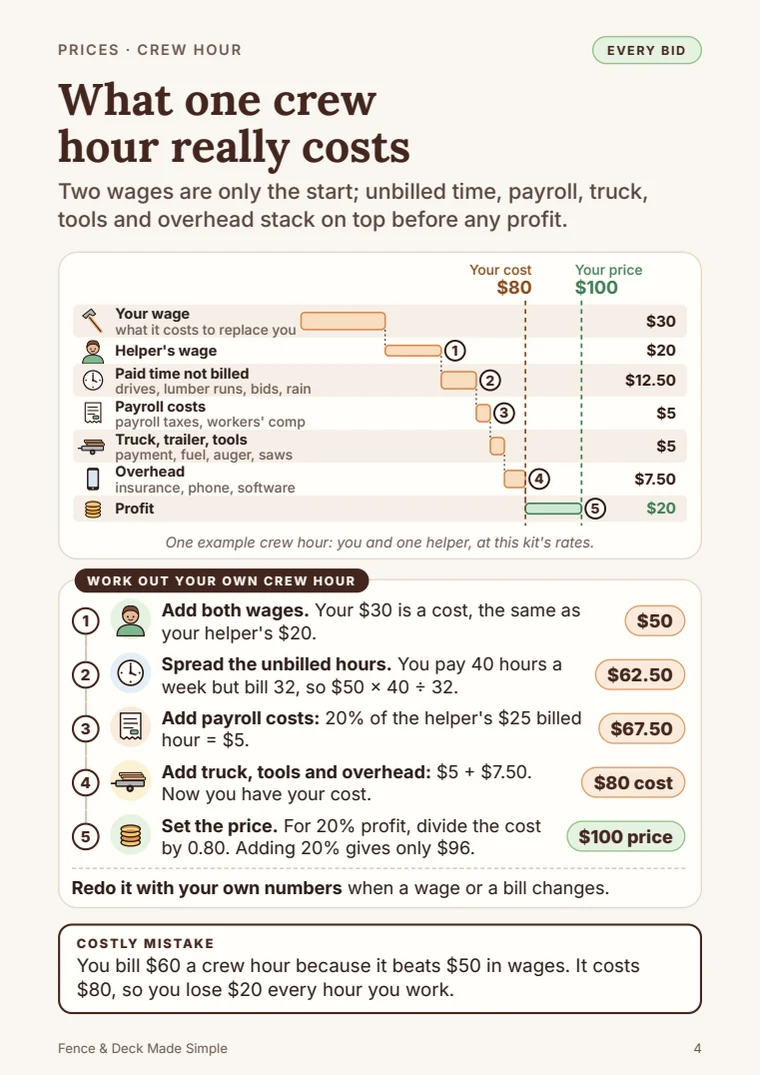
What one crew hour really costs

Book 1, page 4, What one crew hour really costs: in the kit's example, one crew hour costs $80 before any profit and is priced at $100
From Book 1 · page 4
The idea Two wages are only the start; unbilled time, payroll, truck, tools and overhead stack on top before any profit.
Costly mistake You bill $60 a crew hour because it beats $50 in wages. It costs $80, so you lose $20 every hour you work.

A drawing is easier to take in at the tailgate than a paragraph. That's why every page in the kit has one, worked out step by step.

Same truck, same auger. A very different season.

From this

Learning it the expensive way

  • A group thread at midnight that argues with itself about what to charge a foot for cedar privacy
  • A foot price that sounds fair, and no number of your own to check it against
  • Finding out at the end of the season that you built all summer and made nothing
To this

The page for this decision

  • One idea, one drawing, read in a minute
  • The numbers worked out step by step, on the same page
  • The costly mistake named, so you skip it instead of paying for it

One page, up close

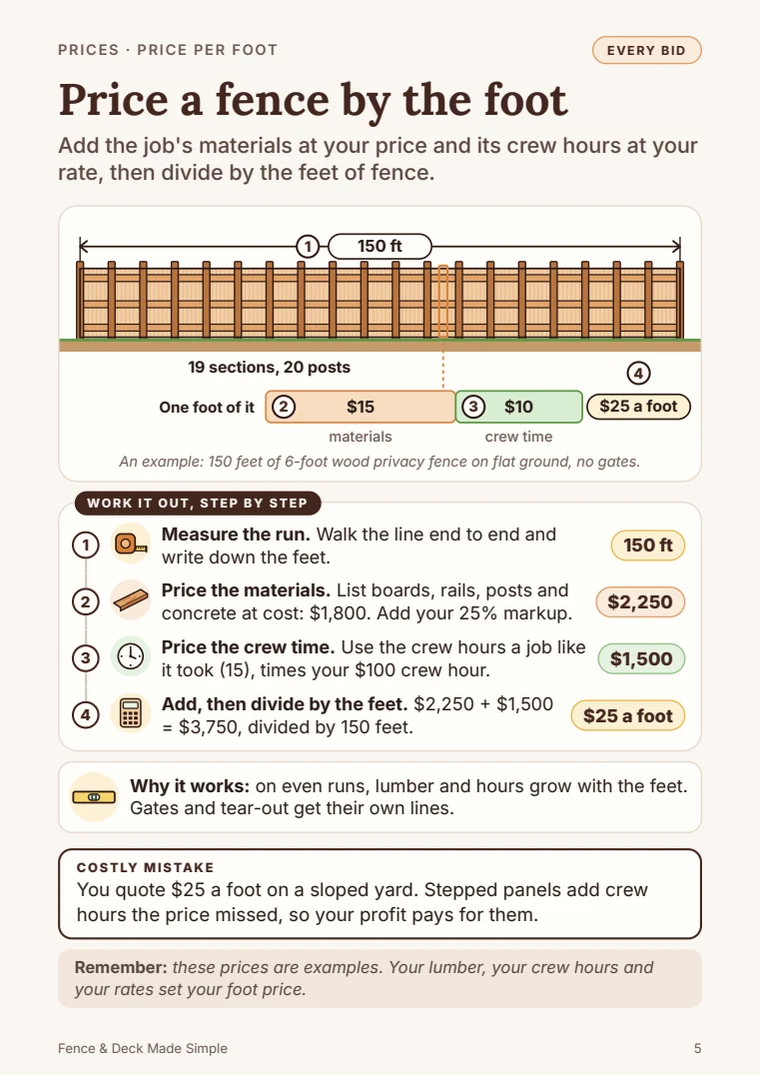
Every page has the same parts, so you always know where to look. Here is Book 1, page 5, Price a fence by the foot, with its lines quoted from the guide.

Book 1, page 5, Price a fence by the foot: the whole page
The idea

Add the job's materials at your price and its crew hours at your rate, then divide by the feet of fence.

Work it out

Add, then divide by the feet. $2,250 + $1,500 = $3,750, divided by 150 feet.

Costly mistake

You quote $25 a foot on a sloped yard. Stepped panels add crew hours the price missed, so your profit pays for them.

Why it works

On even runs, lumber and hours grow with the feet. Gates and tear-out get their own lines.

Quoted from Book 1, page 5. The 150 feet, the $1,800 of materials with a 25% markup, the 15 crew hours at $100 and the $25 a foot on the page are the kit's example figures, labelled as examples. Every page carries these parts plus the drawing, and where a rule changes from state to state, a note that says so.

The three guides

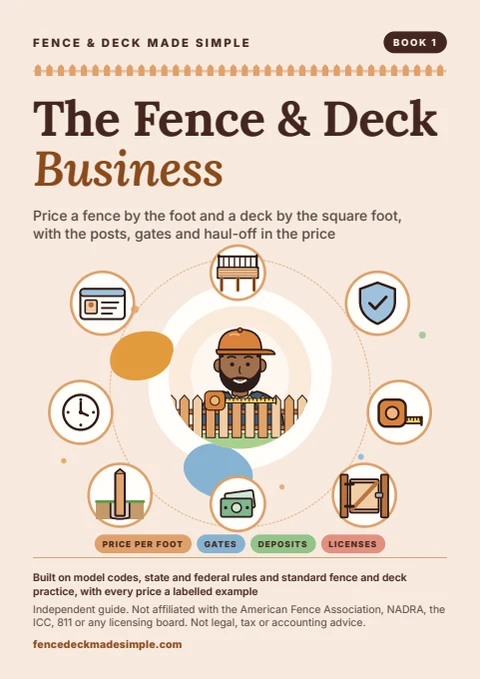
Book 1: The Fence & Deck Business

52 teaching pagesSeven partsEvery page drawnCosts, prices and getting paid

Money first: the first ten pages run the whole money story, then getting paid and contracts, setting up, profit and cash, taxes and safety, one idea a page. Seven parts: The business, Costs and prices, Getting paid, Setting up, Profit and cash, Taxes, and Safety. Start with what one crew hour really costs.

  • The business and prices: you sell feet, square feet and gates, the licenses a fence or deck needs, the four policies a builder carries, what one crew hour really costs, pricing a fence by the foot, what one fence post really costs, pricing a deck by the square foot, gates priced by the each, tear-out, haul-off and the dump
  • Getting paid: deposits and down payment limits, a payment schedule tied to the work, the final walk and the last payment, lien rights as a state pattern, when the client will not pay, what a fence or deck contract holds, the property line is the client's call, change orders before the extra post, the three-day right to cancel, warranties
  • Setting up: sole owner, LLC or corporation, your first-year setup checklist, separate business money, records to keep, working unlicensed, your license number on everything, bonds, general liability, commercial auto for truck and trailer, covering augers, saws and tools, workers' comp when you hire, certificates of insurance
  • Profit, cash, taxes and safety: overhead and your overhead rate per crew hour, markup is not margin, paid hours and billed hours, what an auger costs per hour, materials markup, waste and price jumps, job costing, break-even, cash flow when lumber comes before payment, paying yourself a real wage, profit and loss on one page, the slow season, self-employment and estimated taxes, sales tax on materials and labor, writing off a truck and tools, 1099s, gear for each tool, augers and post drivers, saws, nail guns and treated wood, heat illness
Book 2: Bidding, Selling and Running Jobs

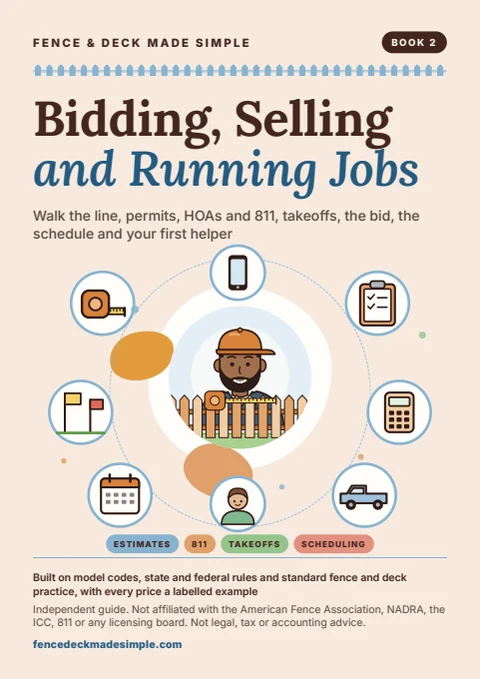
42 teaching pagesSeven partsEvery page drawnFirst call to final walk

Finding the work, walking the line, permits and 811, takeoffs, the bid, running the job and your first helper, in the same layout.

  • Finding the work: fence jobs, deck jobs or both, homes, builders or property managers, a service area you can drive, where leads come from, photos that sell the next job, answering the phone like a business
  • The estimate visit, permits and 811: walking the line with the client, measuring a fence line, slope, rock and roots, old fences, trees and neighbors, measuring a deck, checking the house before a ledger, fence and deck permits, HOA approval, calling 811 before you dig, what locate marks mean, setbacks, easements and pools
  • Takeoffs and the bid: posts, rails and pickets, concrete per hole, chain link and vinyl, a deck from footings to joists, decking and fasteners, railings and stairs, waste and the lumber list, a bid the client can read, good, better, best options, following up, and when to walk away
  • Running jobs and your first helper: scheduling around concrete and weather, ordering and staging materials, a fence job and a deck job day by day, protecting the yard, keeping the client in the loop, inspections and the final walk, reviews and referrals, when to hire, employee or contractor, hiring paperwork, training the helper to set posts, overtime and drive time

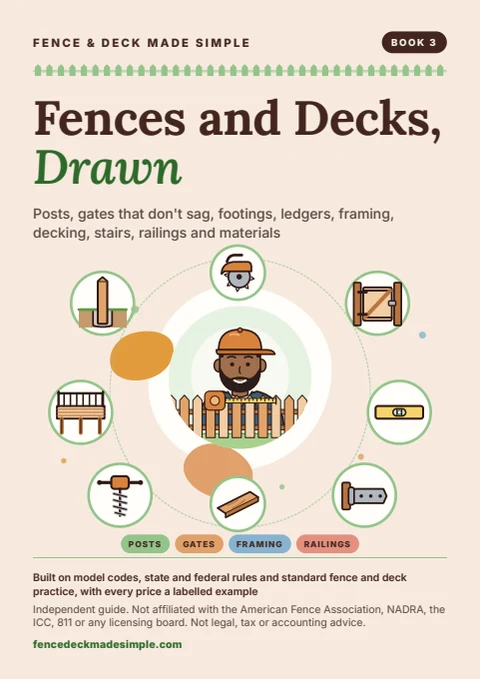
Book 3: Fences and Decks, Drawn

32 teaching pagesFive partsEvery page drawnHow it goes together

How each part of a fence and a deck goes together, one picture to a page, with the mistake that costs a callback.

  • Fences and posts: the parts of a wood fence, privacy, picket and board on board, chain link, vinyl and aluminum, panels or stick-built, post depth and hole size, setting a post in concrete, frost heave and drainage, string line and layout, fences on a slope
  • Gates that don't sag: gate posts and the hinge side, the brace that stops a sag, double gates and drop rods, latches, hinges and pool gates
  • Deck footings and framing: the parts of a deck frame, footings below the frost line, posts and post bases, the ledger with flashing and fasteners, freestanding decks, beams and spans, joists and hangers, blocking and lateral loads
  • Decking, stairs, railings and materials: decking boards and gaps, hidden fasteners or screws, stairs and stringers, guards and handrails as a pattern, railing posts that hold, pressure-treated, cedar or redwood, composite and PVC, fasteners for treated lumber, stain and seal, what wood does as it weathers

Here's everything you get

Bidding, Selling and Running Jobs The Fence & Deck Business Fences and Decks, Drawn

The Fence & Deck Made Simple Kit

  • The Fence & Deck Business57 PDF pages, 52 teaching pages: what one crew hour costs, pricing by the foot and the square foot, posts, gates, haul-off, deposits, contracts, insurance, profit and taxes
    $45
  • Bidding, Selling and Running Jobs47 PDF pages, 42 teaching pages: finding work, walking the line, permits, HOAs and 811, takeoffs, the bid, running jobs and your first helper
    $25
  • Fences and Decks, Drawn36 PDF pages, 32 teaching pages: posts, gates that don't sag, footings, ledgers, framing, decking, stairs, railings and materials
    $25

Total value: $95

Launch price
$27

One-time payment. No subscription. Keep the files forever.

Yes, I want the kit for $27
Secure purchase No subscription 7-day guarantee
Payments by Stripe

Digital guides (PDF), in English. We email your library link right after purchase, and you can download the files again anytime. Plus sales tax where applicable.

Fence & Deck Made Simple is an independent guide for people running a fence and deck business. It explains rules in plain words and is not legal, tax or accounting advice. It is not affiliated with any licensing board or government agency.

Is this kit for you?

Building all season, and the account is still thin

The schedule is full and the money isn't there. What one crew hour really costs, the foot price, the post, gates, tear-out and haul-off, markup and margin, job costing and break-even each get a page, worked with the kit's example rates you can swap your own into.

Pricing off what the other guy charges

Build your own foot price the way the book lays it out: your crew hour, your materials at your markup, the feet, then gates, posts and haul-off as their own lines, in a bid the client can read with good, better and best options.

Going out on your own

You can set a post and frame a deck; the business side is new. Book 1 lays out the licenses as a state pattern, insurance, the contract, deposits your state allows and the cancel rule, then what one crew hour really costs before your first bid.

How this kit is made

No gimmicks. Federal rules, the model code, state boards as labelled examples and makers' instructions, drawn clearly, with the source named on the page where it matters.

Built on named sources

The tax, payroll and 1099 pages follow IRS publications and the overtime pages the Department of Labor's rules; the safety pages follow OSHA; the cancel-rule page follows the FTC's Cooling-Off Rule; the deck pages teach the model residential code's pattern for guards, footings and ledgers and send you to your building department; the license and deposit pages show state rules as labelled examples, like California's. Every page was checked against its named sources before release.

Honest about your state and city

Licenses, deposit limits, lien rules, permits, 811 wait times and deck code change from state to state and city to city. Those pages teach the shared pattern, label any one rule as an example, and point you to where yours lives: your state board, your building department or your state's 811 center.

Example numbers, shown working

The money pages work the same example rates all the way through: your $30 wage and a $20 helper, a crew hour that costs $80 and is priced at $100, materials marked up 25%, a $70 line post, a 150-foot fence at $25 a foot and a 10 by 20 foot deck. You can see where each number comes from and swap in your own. The examples are examples, not prices for your market.

Independent, on purpose

Not affiliated with or endorsed by the American Fence Association, the North American Deck and Railing Association (NADRA), the International Code Council (ICC), the Common Ground Alliance (811) or any state one-call center, any state contractor licensing board, any building department, insurer, lender or online platform, any maker of lumber, fencing, decking, hardware or tools, the IRS, OSHA, the Department of Labor, the Federal Trade Commission or any government agency. We answer to the builder.

7-day money-back guarantee

Use the kit for 7 days. If it isn't for you, email us and you get 100% of your money back. No fine print, no hassle.

Questions, answered

How do I get it?

Right after purchase we email you a link to your library, where you download all three guides as PDFs. You can come back and download them again anytime.

Is this a one-time payment or a subscription?

One-time payment of $27. No subscription, no recurring charges, and nothing to cancel. All three guides are yours to keep.

Who is it for?

Solo and two- or three-person fence and deck builders in their first few years, and carpenters or crew leads about to go out on their own. The kit covers residential fences, gates and decks, priced by the foot, the square foot and the each.

Which state is it for?

Every state. The books teach what works the same way everywhere: pricing, bidding, insurance, getting paid and how fences and decks go together. Where a rule changes by state or city, like contractor licenses, deposit limits, permits, 811 wait times or deck guard heights, the page says so and shows you where to look up yours.

Is it legal or tax advice?

No. Fence & Deck Made Simple is an independent guide for people running a fence and deck business. It explains rules in plain words and is not legal, tax or accounting advice. It is not affiliated with any licensing board or government agency. Your lawyer, accountant, insurance agent, your state board and your building department apply the rules to your business.

Do I need to buy anything else?

No. The kit is complete on its own.

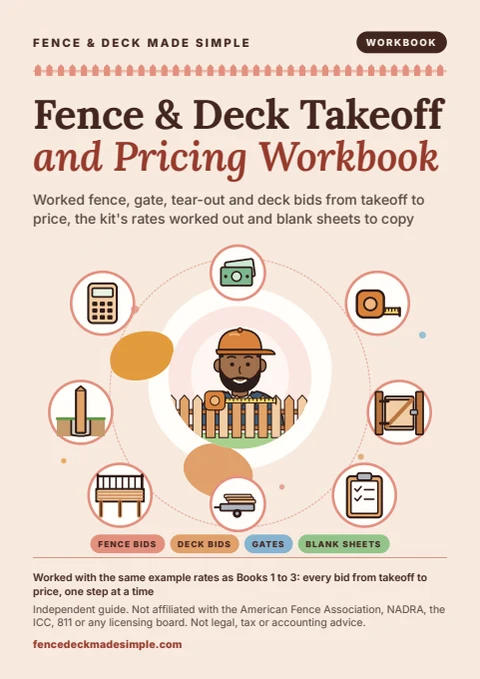
Fence & Deck Takeoff and Pricing Workbook cover

At checkout there is one optional add-on, the Fence & Deck Takeoff and Pricing Workbook: your crew-hour cost and overhead rate worked out, a markup and margin table, worked privacy, chain link, gate, tear-out and deck bids from takeoff to price, and blank crew-hour, fence, deck and bid sheets to copy. It's $9, unticked, and you can skip it.

Can I use it on my phone? Can I print it?

Both. The pages are portrait and phone-sized, so you can check one between jobs, and the PDFs print if you want a page in the truck.

Will it make my business profitable?

We don't promise that, and we'd be wary of anyone who does. The guides show you how each piece works and the mistake that costs money, with the numbers worked on the kit's example rates. Which jobs you take and what you charge is still your call.

What if it isn't for me?

Email us within 7 days of purchase and we'll refund 100% of your money. Details on the refund policy page.

I already bought. How do I get back to my library?

Go to , enter the email you paid with, and we'll email you a 6-digit sign-in code. No password needed. Every file is there to read or download again.

One last thing before you decide

Every month on your own teaches you something about the business side, and the expensive lessons come with a bill. You don't need another midnight group thread or a foot price someone swears by. You need the page for this decision, with the money worked out and the mistake named. Built for builders who want a business that pays them back.

Get instant access
Access confirmed ·
Full kit$27
Get instant access
The full kit · $273 illustrated guides · 126 pagesGet instant access