Busy all season and still short? Three illustrated guides for running a fence and deck business: crew-hour costs and pricing by the foot; bidding, permits, 811 and running jobs; and fences and decks, drawn. One idea a page, each one drawn.
Real pages from all three guides. One idea a page, drawn, with the money worked out.
The Fence & Deck Business, Bidding, Selling and Running Jobs, and Fences and Decks, Drawn. 126 pages, one idea each.
The idea, the picture, the steps worked out and the costly mistake. Read it in the truck between jobs.
Phone-sized PDFs to check at the kitchen table or at the tailgate, yours to keep. Nothing to cancel.
You can set a post plumb. Nobody taught you the money.
Most of the money a fence and deck business loses goes quietly: a foot price copied from someone else, posts and gates hidden in the footage, the old fence hauled off for free, your own hours left out of the price, a deposit your state doesn't allow. Every one of them has a page, and every page names the mistake.
The money pages: where fence and deck builders lose money

A drawing is easier to take in at the tailgate than a paragraph. That's why every page in the kit has one, worked out step by step.
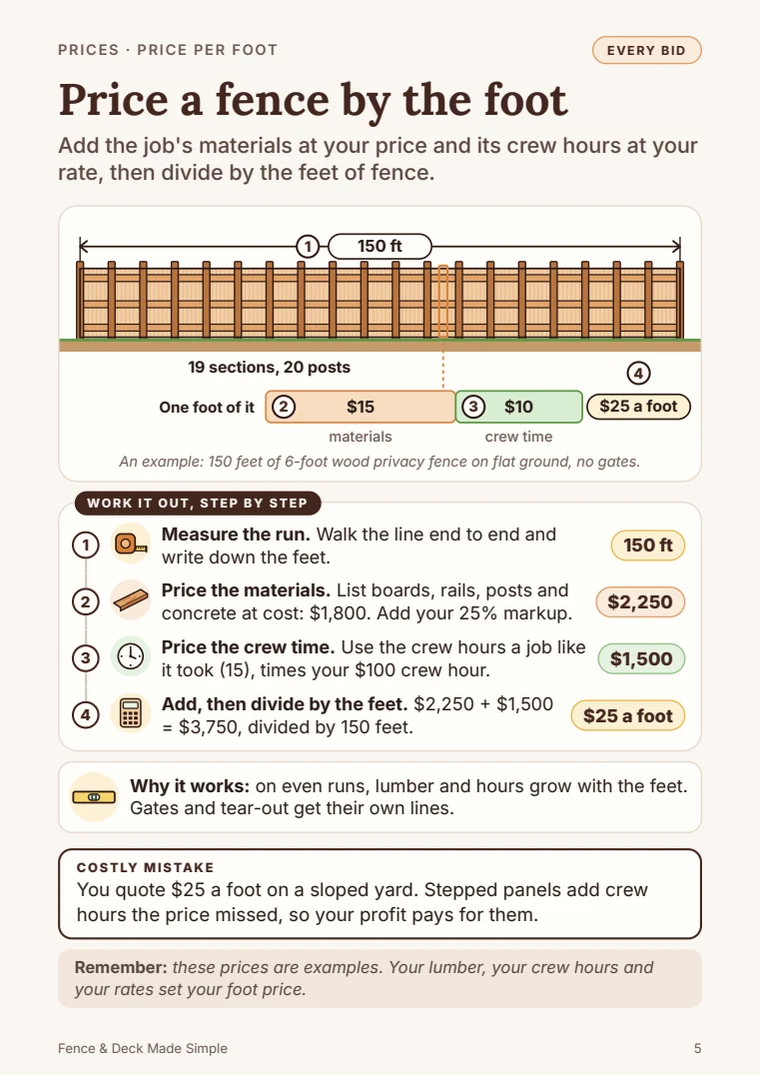
Every page has the same parts, so you always know where to look. Here is Book 1, page 5, Price a fence by the foot, with its lines quoted from the guide.

Add the job's materials at your price and its crew hours at your rate, then divide by the feet of fence.
Add, then divide by the feet. $2,250 + $1,500 = $3,750, divided by 150 feet.
You quote $25 a foot on a sloped yard. Stepped panels add crew hours the price missed, so your profit pays for them.
On even runs, lumber and hours grow with the feet. Gates and tear-out get their own lines.
Quoted from Book 1, page 5. The 150 feet, the $1,800 of materials with a 25% markup, the 15 crew hours at $100 and the $25 a foot on the page are the kit's example figures, labelled as examples. Every page carries these parts plus the drawing, and where a rule changes from state to state, a note that says so.
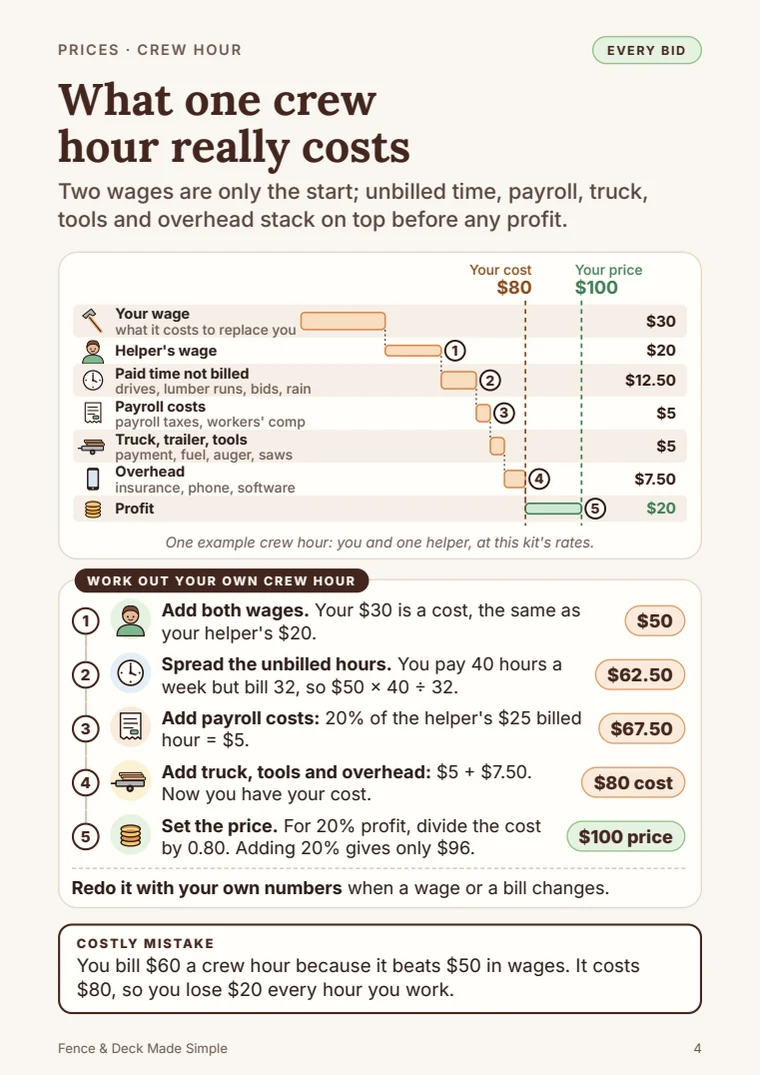
Money first: the first ten pages run the whole money story, then getting paid and contracts, setting up, profit and cash, taxes and safety, one idea a page. Seven parts: The business, Costs and prices, Getting paid, Setting up, Profit and cash, Taxes, and Safety. Start with what one crew hour really costs.
Finding the work, walking the line, permits and 811, takeoffs, the bid, running the job and your first helper, in the same layout.
How each part of a fence and a deck goes together, one picture to a page, with the mistake that costs a callback.
Total value: $95
One-time payment. No subscription. Keep the files forever.
Digital guides (PDF), in English. We email your library link right after purchase, and you can download the files again anytime. Plus sales tax where applicable.
Fence & Deck Made Simple is an independent guide for people running a fence and deck business. It explains rules in plain words and is not legal, tax or accounting advice. It is not affiliated with any licensing board or government agency.
The schedule is full and the money isn't there. What one crew hour really costs, the foot price, the post, gates, tear-out and haul-off, markup and margin, job costing and break-even each get a page, worked with the kit's example rates you can swap your own into.
Build your own foot price the way the book lays it out: your crew hour, your materials at your markup, the feet, then gates, posts and haul-off as their own lines, in a bid the client can read with good, better and best options.
You can set a post and frame a deck; the business side is new. Book 1 lays out the licenses as a state pattern, insurance, the contract, deposits your state allows and the cancel rule, then what one crew hour really costs before your first bid.
No gimmicks. Federal rules, the model code, state boards as labelled examples and makers' instructions, drawn clearly, with the source named on the page where it matters.
The tax, payroll and 1099 pages follow IRS publications and the overtime pages the Department of Labor's rules; the safety pages follow OSHA; the cancel-rule page follows the FTC's Cooling-Off Rule; the deck pages teach the model residential code's pattern for guards, footings and ledgers and send you to your building department; the license and deposit pages show state rules as labelled examples, like California's. Every page was checked against its named sources before release.
Licenses, deposit limits, lien rules, permits, 811 wait times and deck code change from state to state and city to city. Those pages teach the shared pattern, label any one rule as an example, and point you to where yours lives: your state board, your building department or your state's 811 center.
The money pages work the same example rates all the way through: your $30 wage and a $20 helper, a crew hour that costs $80 and is priced at $100, materials marked up 25%, a $70 line post, a 150-foot fence at $25 a foot and a 10 by 20 foot deck. You can see where each number comes from and swap in your own. The examples are examples, not prices for your market.
Not affiliated with or endorsed by the American Fence Association, the North American Deck and Railing Association (NADRA), the International Code Council (ICC), the Common Ground Alliance (811) or any state one-call center, any state contractor licensing board, any building department, insurer, lender or online platform, any maker of lumber, fencing, decking, hardware or tools, the IRS, OSHA, the Department of Labor, the Federal Trade Commission or any government agency. We answer to the builder.
Use the kit for 7 days. If it isn't for you, email us and you get 100% of your money back. No fine print, no hassle.
Right after purchase we email you a link to your library, where you download all three guides as PDFs. You can come back and download them again anytime.
One-time payment of $27. No subscription, no recurring charges, and nothing to cancel. All three guides are yours to keep.
Solo and two- or three-person fence and deck builders in their first few years, and carpenters or crew leads about to go out on their own. The kit covers residential fences, gates and decks, priced by the foot, the square foot and the each.
Every state. The books teach what works the same way everywhere: pricing, bidding, insurance, getting paid and how fences and decks go together. Where a rule changes by state or city, like contractor licenses, deposit limits, permits, 811 wait times or deck guard heights, the page says so and shows you where to look up yours.
No. Fence & Deck Made Simple is an independent guide for people running a fence and deck business. It explains rules in plain words and is not legal, tax or accounting advice. It is not affiliated with any licensing board or government agency. Your lawyer, accountant, insurance agent, your state board and your building department apply the rules to your business.
No. The kit is complete on its own.

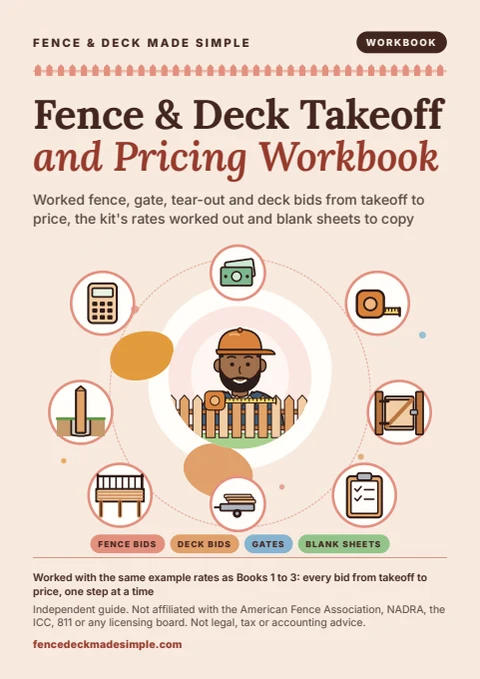
At checkout there is one optional add-on, the Fence & Deck Takeoff and Pricing Workbook: your crew-hour cost and overhead rate worked out, a markup and margin table, worked privacy, chain link, gate, tear-out and deck bids from takeoff to price, and blank crew-hour, fence, deck and bid sheets to copy. It's $9, unticked, and you can skip it.
Both. The pages are portrait and phone-sized, so you can check one between jobs, and the PDFs print if you want a page in the truck.
We don't promise that, and we'd be wary of anyone who does. The guides show you how each piece works and the mistake that costs money, with the numbers worked on the kit's example rates. Which jobs you take and what you charge is still your call.
Email us within 7 days of purchase and we'll refund 100% of your money. Details on the refund policy page.
Spotted an error, or a rule that works differently in your state or city? Email [email protected]. A real person reads every message, and fixes go into the next version.
Every month on your own teaches you something about the business side, and the expensive lessons come with a bill. You don't need another midnight group thread or a foot price someone swears by. You need the page for this decision, with the money worked out and the mistake named. Built for builders who want a business that pays them back.